
Termites in a Basement: What Visible Signs Mean
A line of packed earth on a basement wall raises a different question from pale insects inside a stored board. One may point to a route on the building; the other may be limited to an item. Before deciding what to do, record exactly where you found the clue and whether the nearby foundation and framing are visible.
Short Answer
Suspected mud tubes on a basement foundation wall, live termites in fixed wood, or swarmers seen emerging from the structure warrant a licensed termite inspection. A damp stain, musty smell, or bare crack does not establish a termite infestation. Photograph the clue and its location without removing finishes or disturbing possibly weakened wood. If a beam, post, joist, or stair appears unsafe, keep clear and ask a qualified building professional to assess its strength as a separate question.
An unfinished basement may expose the foundation wall and wood above it. In a finished basement, wallboard, insulation, flooring, and storage can conceal the same areas. A clean visible surface cannot tell you what is behind them. Start with the whole-house inspection checklist if you need a broader walkthrough; this guide focuses on interpreting a basement find.
Signs of Termites in a Basement
Mud tubes on masonry or wood
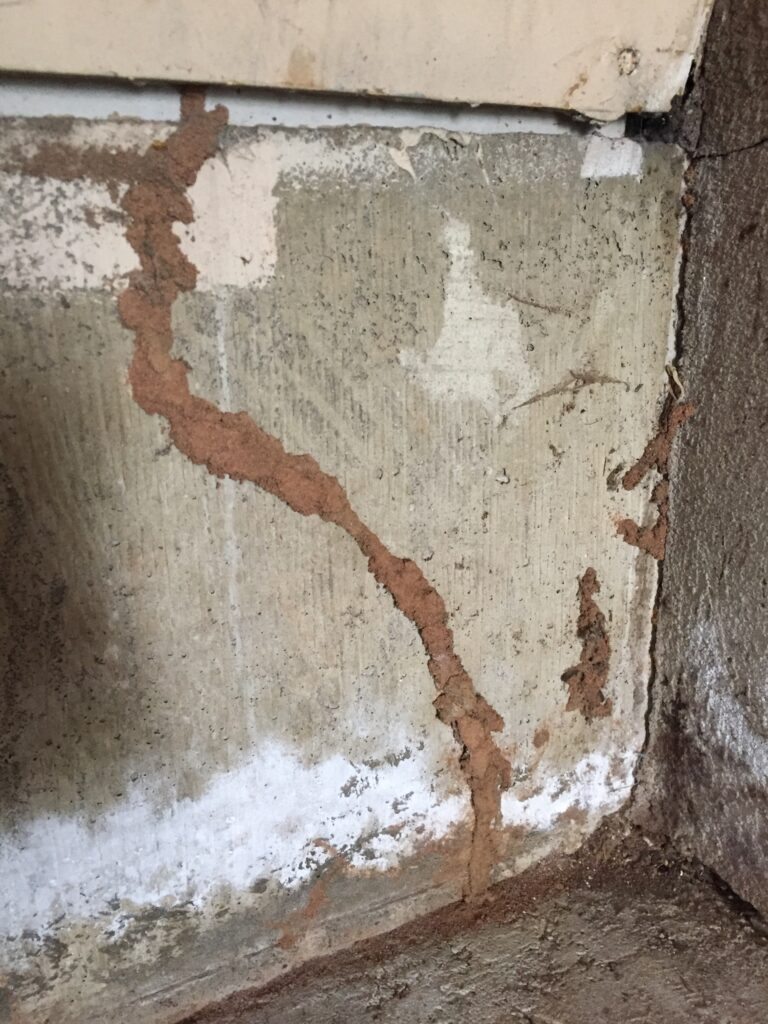
Earthen shelter tubes on the inside face of the foundation, a post, a stud, or the sill plate (mudsill) at the top of the wall. Penn State Extension lists cellar walls, wooden posts, wall studs, and mudsills as places where they appear.
Damaged wood at the top of the wall
A sill plate, rim joist, or post with hollow, enclosed galleries running along the grain, sometimes under a thin surface that still looks intact. UC IPM describes this pattern. Do not pry the wood open to check.
Wings or swarmers at a window
Winged insects or shed wings collected at a basement window or light. One or a few may have come in from outside; many confirmed termite swarmers indoors warrant a prompt inspection. Photograph an intact insect before you clean up.
Pellets are not a subterranean sign
Subterranean termites, the type that typically reaches a basement from the soil, do not push piles of pellets out of wood. Small, hard, six-sided pellets point to drywood termites where they occur; coarse shavings may suggest carpenter ants.
No single item on this list proves an active infestation, and a clean wall does not rule one out behind storage or finishes. For the house-wide evidence list, see signs of termites; to judge what a tube you found can and cannot tell you, see mud tubes versus old damage. The table below helps you sort where the clue is.
First, Locate What You Found
→ Scroll the table sideways to see all columns.
| Where the clue is | What it may mean | Sensible next step |
|---|---|---|
| Inside a loose board, box, or other stored item | The item may contain wood-destroying insects. That alone does not establish activity in the basement structure. | Photograph the item in place and the insects or damage. Check safely visible nearby building surfaces for a separate clue. |
| Under or beside a stored item, rather than inside it | The insects could have come from the item, the floor edge, fixed wood, or elsewhere. Their position does not identify the source. | Photograph the uncovered surface and look for a visible tube or opening connected to the building. |
| On an interior foundation wall, a fixed post, sill plate, or exposed framing | An earthen tube, live termites, or damage connected to the structure raises a building question. | Leave the evidence intact and arrange a licensed termite inspection. |
| Only a damp stain, odor, mold, or bare crack | Moisture or an opening deserves attention, but neither confirms termites. | Find and address the water source; document any new insect evidence separately. |
| At a visibly sagging or compromised beam, post, joist, or stair | The cause and remaining strength cannot be judged from appearance alone. | Keep people away from the area and seek a qualified building or structural professional. Arrange a termite inspection too if insect evidence is present. |
Do not move a suspect item just to see what is behind it if doing so would erase a tube or damage a building clue. Take a wider photograph first. If it can later be moved safely without disturbing evidence, keep it separate from clean storage and do not carry it to another property while its contents are uncertain. The garage guide explains the same item-versus-building distinction in that setting.
What You Can See in an Unfinished Basement
Look only at areas you can reach and see safely. Depending on the house, that may include the inside face of the foundation, its visible joints and openings, exposed sill plates or rim joists at the top of the wall, accessible posts and framing, and the bases of stairs or fixed wood trim. Penn State Extension identifies cellar walls, wooden posts, wall studs, and mudsills as places where subterranean termite tubes can appear. In Pennsylvania, the same source says most infestations are found in basement or cellar areas and in the timbers just above the cellar walls; see our Pennsylvania termite guide. This is a guide to likely observation points, not a claim that every mark there was made by termites.
Note where a tube begins and what surface it crosses. A tube on masonry is more specific evidence than a crack in masonry, but it does not necessarily prove that termites reached the wood above it. UC IPM describes exploratory tubes that do not connect to wood. Photograph the entire visible path; do not trace it by breaking it open.
An exposed basement can still have hidden areas. Storage may block the wall-to-floor edge, insulation may cover the rim joist, and a finished room may occupy part of the same level. Skip any area with standing water, exposed wiring, unstable footing, or suspected structural weakness. Tell an inspector what you could not see rather than trying to open it yourself.
What Changes in a Finished Basement?
A finished basement can hide the foundation wall and framing behind wallboard, paneling, insulation, built-ins, or flooring. You may still see a clue near a baseboard, window, door trim, utility opening, or exposed service area. On drywall or paneling, note any small spots of dried mud that resemble pinholes, or narrow, sunken, winding tracks under paint or wallpaper. Termites can make these marks, including by feeding on drywall’s paper facing, but a surface mark alone does not identify its cause. Photograph it and have a suspicious building-associated mark checked. Mississippi State University Extension describes these clues in more detail.
Mississippi State University Extension also notes that subterranean termites may tunnel through foam insulation while searching for wood, although they do not eat the foam. The insulation can conceal that route. Seeing intact foam does not establish that the foundation or framing behind it has been inspected. Record which surfaces the insulation covers; do not remove it to look for tunnels.
Do not pull trim, cut wallboard, lift flooring, or open an electrical box to investigate. A stain or bubbling paint may come from water, decay, or another cause. Our termites in walls guide covers visible clues at finished surfaces; termite damage vs. water damage gives the fuller material comparison. If an inspector cannot see behind the finish, ask which specific areas remained inaccessible and how that limits the conclusion. “No visible evidence” is not an all-clear for concealed framing.
Is That a Mud Tube or Just a Crack?
Subterranean termites can build protected earthen tubes across masonry to reach food, while an existing joint, crack, or gap can offer a route toward wood. They do not eat through intact concrete. A bare opening is therefore a possible route, not proof that termites used it. Basement construction varies; do not assume that a floor joint in one house works like the slab detail in another.
If you suspect a tube on the building, take a close photograph and a second image showing its position on the wall, post, or framing. Do not judge it “inactive” because it looks dry or appears empty. Mississippi State University Extension recommends a professional inspection for shelter tubes on a building even when live termites are not seen. Our mud tubes versus old damage guide explains why one tube cannot clear the rest of the structure.
What If You Find Wings, Pellets, Damaged Wood, or Only Moisture?
Winged insects or shed wings: Photograph an intact insect if possible. One or a few insects at a window may have entered from outside, and wings alone do not locate their source. Many confirmed termite swarmers indoors raise greater concern and warrant a prompt inspection. Seeing them actually emerge from fixed wood, a basement wall, or another part of the structure is stronger evidence that the building is involved. Identify the insects before choosing a response; the indoor swarmers guide explains the termite-versus-ant check. Mississippi State University Extension describes why the number and observed point of emergence matter.
Small hard pellets: Where drywood termites occur, their pellets can collect beneath an opening in infested wood, including wood in a stored item or part of the building. Pellets alone do not show which wood they came from or whether activity continues. Photograph the pile and any visible opening, and have suspected building-associated evidence identified. UC IPM describes the pellet clue; the location still has to be checked.
Damaged fixed wood: Record the location and any visible soil-like material, galleries, insects, or nearby tubes. Do not poke or pull apart a sill plate, post, stair, beam, or joist to test its strength. Damage may be old, insect-related, moisture-related, or a combination; an image cannot establish its full extent. A licensed termite inspector can evaluate insect evidence, while a qualified building professional should address any concern about structural safety.
Other wood-destroying insects: Coarse wood shavings with insect fragments may suggest carpenter ants, while small round exit holes with fine powder can suggest certain wood-boring beetles. Neither pattern is enough to identify the insect from a pile of debris. Photograph the material and the wood it appears to come from, and ask for identification before accepting a termite-specific treatment. Penn State Extension and the University of Minnesota Extension describe these lookalikes.
Moisture without identified insects: Fixing a leak or drainage problem matters even when no termite evidence is visible. Dampness and a musty smell are not termite tests. Photograph changes and check accessible nearby surfaces, then use our damage-versus-water guide if wood has softened, swollen, or decayed. Avoid treating the basement for termites solely because it is damp.
Document the Clue Before an Inspection
Take one wider photo that shows where the clue is in the basement, then a close-up only if you can do so safely. Put a ruler or another familiar-sized object beside the clue for scale if that will not disturb it or put you at risk. Record the date; whether the area is finished or unfinished; the exact wall, post, stair, or stored item; any known leak; dates and findings of previous inspections or treatments, if available; and whether new signs have appeared since. Separate what you directly observed from what you infer. “Insects came out of this board” is more useful than “insects were on the floor beside it.”
Tell the inspector which surfaces are hidden by finish, insulation, built-ins, or storage. Ask what was identified, which exact areas could not be inspected, how that limits the findings, and whether a treatment recommendation rests on live insects, a tube, old damage, or another finding. Our professional termite inspection guide explains what a visit can and cannot establish.
Your Next Step
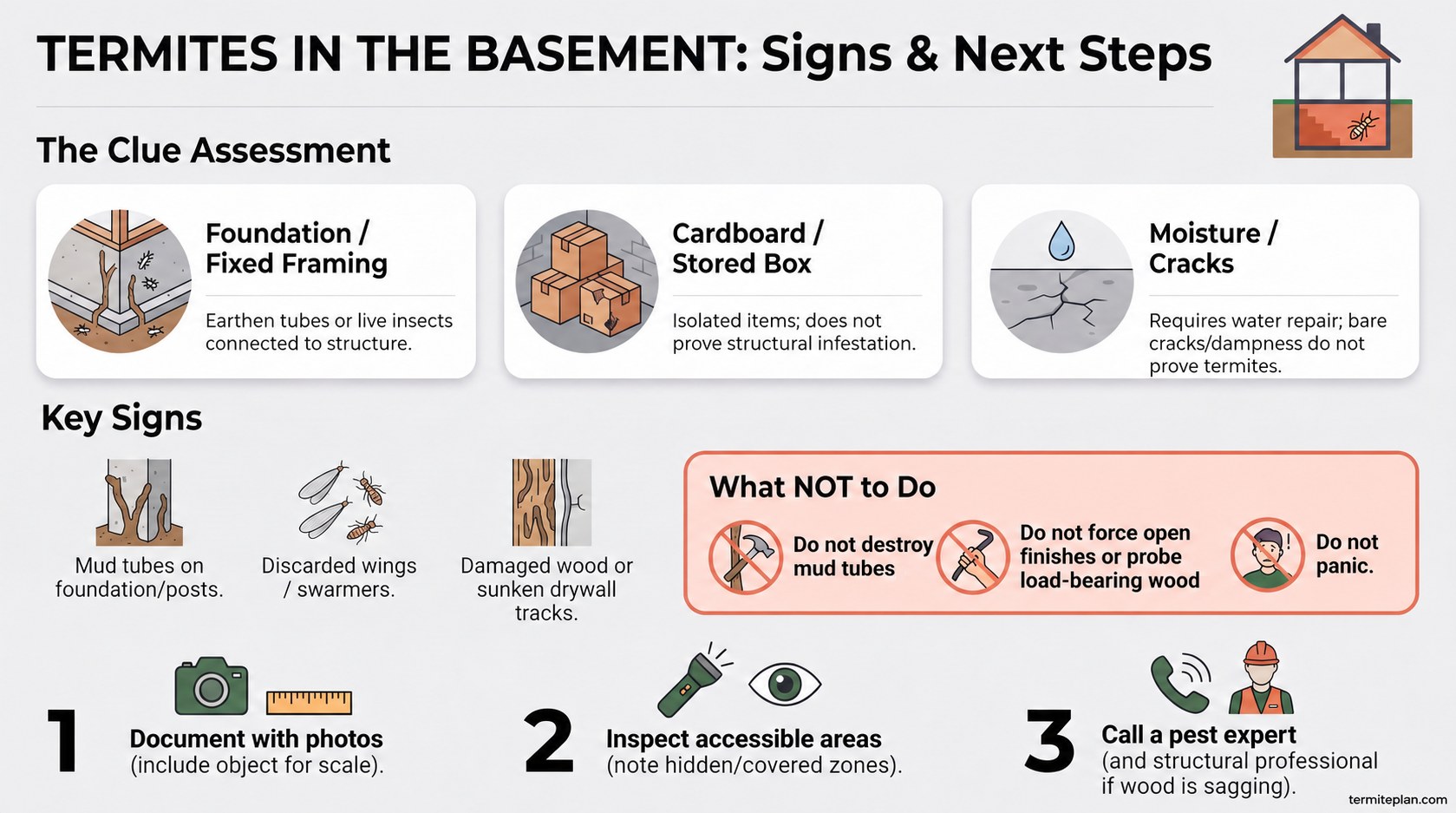
If the finding is limited to a movable item, document it and check for separate evidence on the building. If you suspect a tube or live termites on the foundation or fixed wood, arrange a licensed termite inspection without disturbing the clue. If the only finding is moisture, address the water source and keep watching for distinct insect evidence. If supporting wood or stairs may be weakened, keep clear and request a qualified building assessment; a pest inspection does not measure structural strength.
Cold weather does not turn a visible basement clue into an all-clear. The response depends on the evidence and the building, not the month. See what winter means for termite activity for the seasonal limits. Basements are common in Ohio, where OSU Extension advises checking houses for mud tubes every year; see our Ohio termite guide.
Sources
- Penn State Extension, “Eastern Subterranean Termites” — cellar walls, posts, mudsills, and other visible locations; updated June 24, 2026.
- Mississippi State University Extension, “Signs of Termite Infestation” — shelter tubes, indoor swarmers, mud pinholes, sunken tracks, foam insulation, and when to seek inspection.
- UC IPM, “Subterranean and Other Termites” — shelter-tube types and limits of visual interpretation; updated May 2014.
- U.S. EPA, “Termites: How to Identify and Control Them” — identification, foundation openings, moisture prevention, and professional treatment decisions.
- NC State Extension, “Monitoring and Management of Eastern Subterranean Termites” — inspection limits and differences in access for finished and unfinished areas.
- Penn State Extension, “Carpenter Ants” — coarse wood particles and other carpenter-ant clues.
- University of Minnesota Extension, “Powderpost Beetle” — small round exit holes and fine, powder-like debris.