Identification guide
Termite Swarmers Inside Your House: What to Do Next
Winged insects at a window can be unsettling. What matters first is whether they are termites, how many you found, and whether you saw them emerge from the building or only found them nearby.
Short Answer
If you see suspected termite swarmers emerging from a wall, ceiling, floor, or other part of your home, arrange a professional termite inspection. Take photos of the insects and their location, and save a few specimens if you can. A few winged insects near an open window may have flown in from outdoors, so their presence alone does not prove the house is infested. Either way, identifying the insects comes before choosing a treatment.
This guide is part of our termite identification guides. For a close comparison of wings, antennae, and body shape, see flying ants vs. termites.
What to Do When You Find Them
- Record the scene. Photograph the insects close up and take a wider photo that shows the window, wall, floor, or opening where you found them. Note the date, room, and whether you saw them emerge from the structure.
- Keep a sample. Put a few insects and any shed wings in a small container for an inspector or local identification service. Avoid crushing the bodies or mixing them with debris.
- Check without disturbing the structure. Look at accessible window sills, baseboards, and nearby surfaces for more insects or wings. Do not open walls, remove trim, or disturb possible termite tubes to hunt for a nest.
- Arrange an inspection when the evidence points to termites. Visible emergence from the building, many swarmers indoors, or repeated findings deserve prompt attention from a qualified termite professional. If you already have a termite contract, call that provider and describe what you observed.
Do not rely on an aerosol spray or vacuuming as a termite treatment. Removing the visible swarmers does not address the colony that produced them. You can clean up after documenting the scene and keeping a sample.
Does Finding Swarmers Indoors Mean the House Is Infested?
They emerged from a wall, ceiling, floor, or trim
This is the most concerning pattern. The insects appear to be exiting the structure itself, which is strong evidence of an established termite problem. Have the building inspected; do not use the visible swarm to guess how extensive the hidden activity or damage is.
You found a few near a window or light
A few swarmers can fly or crawl inside from outdoors. This is particularly relevant in areas with Formosan termites, which can swarm at night and be drawn toward lights. The location is still worth documenting, but finding a few insects there does not establish where they came from. Numerous insects indoors or repeated appearances strengthen the case for inspection.
You found only discarded wings
Wings can remain after a swarm. They tell you that winged insects were present, but not exactly when the event happened or where a colony is located. Save a sample, check whether the wings match termites, and arrange an inspection if there are indoor accumulations or other termite signs.
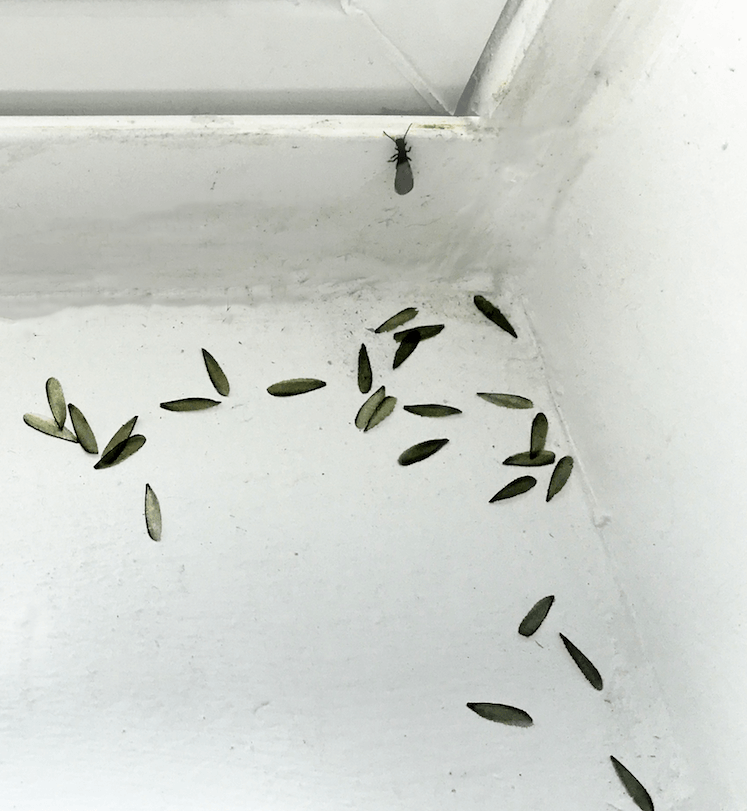
Make Sure They Are Termites
Termite swarmers generally have a broad waist, fairly straight antennae, and front and hind wings of similar length. Winged ants usually have a pinched waist, elbowed antennae, and front wings longer than the hind wings. A blurred photo or a pile of loose wings may not settle the question. Use our photo comparison, then ask a local extension identification service or pest professional if you remain unsure.

Swarm timing and color vary by species and region. Do not diagnose the species, treatment method, or colony location from a photo alone. See termite types if an inspector identifies the group.
What to Tell the Inspector
- The room and exact spot where you first saw the insects or wings.
- Whether you watched them emerge from the building or only noticed them near a window, door, or light.
- Whether this happened once or repeatedly, and whether you have photos or specimens.
- Any nearby mud tubes, pellets, leaks, or damaged wood.
- Any previous treatment and the terms of an existing termite contract.
If wings or suspected swarmers appeared in an attic together with pellets, mud, or damaged roof framing, our attic evidence guide helps sort those location-specific clues without assuming the termite type.
An inspector can assess areas you cannot see and explain whether the evidence calls for monitoring, further investigation, or treatment. Our inspection checklist can help you organize observations; it cannot certify that hidden areas are clear.
If treatment is proposed, ask what evidence supports the diagnosis, which areas will be addressed, and what the written contract covers. You can compare providers using our questions to ask a termite company. A swarm is reason to act, but you do not need to accept a pressured same-day sale.
Sources
- Mississippi State University Extension: Signs of Termite Infestation
- Mississippi State University Extension: Protect Your House from Termites
- University of Maryland Extension: Termites
- U.S. EPA: Termites: How to Identify and Control Them
- U.S. EPA: Tips for Selecting a Pest Control Service
For our editorial process, see Methodology.