
Garage inspection guide
Termites in a Garage: Stored Wood or Building Problem?
You moved a stack of lumber and saw pale insects. Or you noticed an earthen line where the garage floor meets the wall. Both deserve a closer look, but they raise different questions. The first may be limited to an item you stored. The second may be evidence that termites have reached the garage structure.
The useful next step is to record exactly where the clue is before deciding what it means. A garage often hides its floor edges behind boxes, shelves, and vehicles. In an attached garage, the connection to the house also matters.
Short Answer
Termites in a loose piece of firewood or lumber do not, by themselves, prove that the garage or house is infested. Mud tubes on the garage foundation, slab edge, or fixed framing; live termites in attached wood; or swarmers emerging from the structure call for a licensed termite inspection. Photograph the clue and its location before moving or cleaning anything. If the evidence is limited to a movable item, inspect the nearby accessible building surfaces as well; a clean view is useful, but it cannot rule out hidden activity.
If the discovery is only in logs intended for a fireplace, start with our termites in firewood guide. This page focuses on whether the garage itself shows evidence.
First, Locate the Evidence
The question is not just “Are these termites?” It is “What are they in or on?” A quick location map prevents a small clue from turning into an unsupported conclusion.
→ Scroll the table sideways to see all columns.
| Where you found it | What it may mean | Sensible next step |
|---|---|---|
| Inside a loose log, board, cardboard box, or stored furniture | Insects or galleries within the item raise concern that the item is infested; they do not, by themselves, establish activity in garage framing. | Photograph the item and its original position. Check accessible nearby building surfaces without disturbing suspected structural evidence. |
| Under or beside a stored object, rather than inside it | The insects could have come from the object, the floor edge, nearby fixed wood, or elsewhere. Their location alone does not identify the source. | Photograph the insects and the uncovered surface; look for a tube, opening, or damage connected to the structure. |
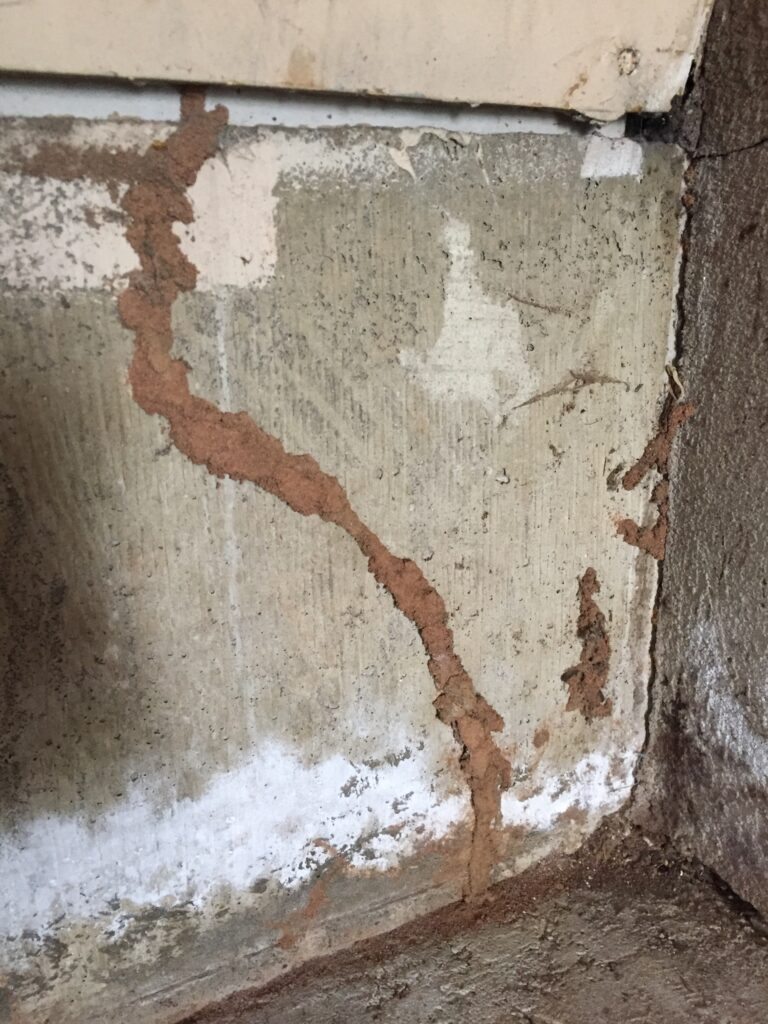
| Earthen line along a slab edge, foundation, step, or fixed post | A possible subterranean termite shelter tube or entry route. Appearance still needs confirmation. | Photograph its path and arrange a licensed inspection, even if you do not see live termites. |
| Small, hard pellets below a possible opening in fixed trim or framing | Distinctive drywood termite fecal pellets can be strong evidence when identified and traced to a kick-out hole, but a pile alone cannot establish that the infestation is active or show its extent; beetle frass and other debris can look different. | Save a few pellets or a clear close-up and photograph the suspected source. Request an inspection if it is part of the building. |
| Swarmers or discarded wings near a garage door or window | Wings show that winged insects were present, but not necessarily where they emerged. | Photograph an intact insect if available. Repeated indoor sightings or insects emerging from fixed wood merit inspection. |
What to Check on the Garage Itself
Start with visible, safely accessible surfaces. Look along the inside and outside foundation edge, the joint where the slab meets a wall or step, the bases of fixed door trim and posts, and any exposed sill or framing. Note water stains, leaks, or wood touching soil or mulch. Do not pull away wall coverings, open electrical boxes, drill the slab, or probe wood that may support the structure.
The North Carolina Pest Management Association’s inspection manual identifies the garage slab-to-foundation joint, wood adjoining an attached garage, steps, and accessible sill plates as important inspection locations. It also notes that stored items can block the view. This does not mean every crack or damp spot is a termite route. It tells you where to record a visible clue and where an inspector may need access.
Concrete is not termite food. Subterranean termites can travel through soil and use existing joints, gaps, or cracks around a slab to reach wood. A tube crossing concrete is more informative than a bare crack; a crack alone is not a termite diagnosis. For how slab construction affects professional treatment decisions, see our slab foundation guide.
A row of small, filled holes in a garage slab could be left from a previous professional termite treatment: NC State Extension describes drilling garage joints and attached slabs to treat soil beneath them. Holes alone neither confirm current termites nor establish when or how well a treatment was done; ask for the property’s treatment records.
Can termites come through a garage floor?
Termites do not eat their way through solid concrete. They can use an existing crack, the joint between a garage slab and foundation, or another opening to reach wood. Insects merely walking on a concrete floor do not identify their source. Check whether there is a visible tube leading from a joint toward fixed wood, or whether the insects were uncovered with a stored board or box. An exploratory mud tube may stop before it reaches structural wood, so even a real tube does not by itself show that garage framing has been entered. Photograph the location before moving anything that may conceal the route. A suspected tube on the structure warrants inspection; a bare crack does not prove termite activity.
Attached garage or detached garage?
In an attached garage, tell the inspector whether the evidence is near the shared wall, a step into the house, or a connected crawl space or foundation. Those details help define the inspection area. They do not prove that termites have spread into the living space.
In a detached garage, the house is a separate structure. A termite finding there still deserves attention, especially if fixed wood is involved, but it does not establish an infestation in the house. Look for visible clues at the house perimeter and report both locations to the inspector.
Stored Wood Is a Different Question
Wood stored in a garage can hold wood-destroying insects. Drywood termites can live within lumber or furniture without soil contact in regions where they occur. Subterranean termite colonies normally depend on soil contact for moisture, but an aboveground colony can persist where another reliable moisture source exists; Formosan subterranean termites are a documented example. Thus, finding insects inside an item does not prove a soil route, and finding them underneath it does not prove they came from the item. Carpenter ants and wood-boring beetles can also be associated with stored wood, so an insect or a pile of debris needs identification before anyone chooses a treatment.
If you can safely inspect a loose item without losing evidence, photograph its original location, any insects, and the damaged area first. Do not spray it, cut into it, or drag it across a suspected tube to make a diagnosis. If the item can be moved without disturbing suspected building evidence, carry it directly outside and isolate it away from buildings; avoid carrying it through living space or taking it to another property. If moving it could damage the evidence or the item is fixed in place, leave it for the inspector. Keep a sample or clear photograph for identification. If you find matching evidence on fixed trim or framing, shift from an item question to a building inspection.
Firewood has its own storage and use rules. Our firewood guide explains why fireplace fuel should not be treated with a pesticide and how to store it away from the building.
Which Signs Need a Professional Inspection?
Arrange a licensed termite inspection when you find a suspected mud tube on the structure, live termites in fixed wood, repeated swarmers inside the garage, pellets apparently coming from fixed wood, or damage to framing, door supports, or the shared wall. Keep people away from visibly weakened wood and ask a qualified building professional to assess structural safety if it is in doubt.
An old-looking or empty tube is not an all-clear. Mississippi State University Extension advises inspection for tubes on a building even when no live termites are visible. Our mud tubes versus old damage guide explains what a tube can and cannot establish about current activity.
When you call, explain where each clue was found and whether the garage is attached. Ask the inspector to identify the insect or evidence, document accessible and inaccessible areas, and explain why any proposed treatment matches the finding. The professional termite inspection guide helps you prepare for that conversation. A garage with no visible evidence today can still have hidden areas; our whole-house inspection checklist gives you a repeatable route for later checks.
Your Next Step
Keep the clue and its location documented, make accessible inspection areas visible, and correct leaks. If a tube, pellets, or damaged wood appear connected to the building, have a licensed inspector identify the evidence and assess the garage and, when attached, the house connection. The drywood termite signs guide can help you describe pellets, but only an inspection can establish their source and the extent of any building infestation. Leave visibly weakened structural wood undisturbed until its safety is assessed.
Sources
- North Carolina Pest Management Association, wood-destroying insect inspection manual, “Inspecting Garages,” pp. 3-36–3-37.
- Mississippi State University Extension, “Signs of Termite Infestation”.
- UC IPM, “Subterranean and Other Termites” and “Drywood Termites”.
- UC IPM, “Wood-Boring Beetles in Homes” and University of Minnesota Extension, “Carpenter Ants”.
- U.S. EPA, “Termites: How to Identify and Control Them” and “Tips for Selecting a Pest Control Service”.
- Mississippi State University Extension, “Methods of Termite Control”; Iowa State University Extension, “Firewood Insects”.
- Mississippi State University Extension, “Species of Termites in Mississippi” (aboveground Formosan colonies).
- University of California Agriculture and Natural Resources, “Termites,” fig. 4 (exploratory tubes may not connect to wood; PDF hosted by Oregon State University).
- NC State Extension, “Monitoring and Management of Eastern Subterranean Termites” (professional drilling of garage joints and attached slabs).