
Treatment guide
Termite Fumigation: How Tenting Works, How to Prepare, and When You Can Go Back
Short Answer
Termite fumigation, often called tenting, seals a house under tarps and fills it with a gas, usually sulfuryl fluoride, that reaches drywood termites hidden inside walls, framing, and furniture. Only certified applicators may use it. Everyone, including pets and houseplants, leaves the house, and food and medicine are removed or sealed in special bags unless they are in unopened airtight containers.
Depending on the house, the dose, and the temperature, California’s pest control board says a fumigation can take from six hours to a week, and most families plan to be away for several days. You go back only after the company has aerated the house, tested the air, and posted a re-entry notice. Fumigation leaves no residue, so it does not protect against new termites, and it is not the usual treatment for subterranean termites that live in the soil.
When Fumigation Is the Recommended Treatment
Fumigation is mainly a drywood termite treatment. Drywood colonies live inside the wood they eat and do not need contact with soil, so a house can hold several hidden colonies at once. UC IPM describes whole-structure treatment as treating every infestation in a building at the same time, accessible or not, which localized treatments cannot guarantee. That is why a company may recommend tenting when the evidence, such as piles of pellets or kick-out holes, shows up in more than one area or the extent cannot be mapped.
It is usually not the right comparison for subterranean termites. Their colonies live in the soil under and around the house, which the gas inside a tented building does not reach. They are managed with soil treatments or bait systems instead. If you are not sure which termite you have, start with our subterranean vs. drywood vs. dampwood comparison and the guide to termite droppings vs. frass.
If the evidence is limited to one accessible spot, ask whether a localized option would work. Our guide to termite treatment without tenting explains when that can be reasonable and when it may miss part of the problem.
How Tenting Works, Step by Step
1. Sealing the house
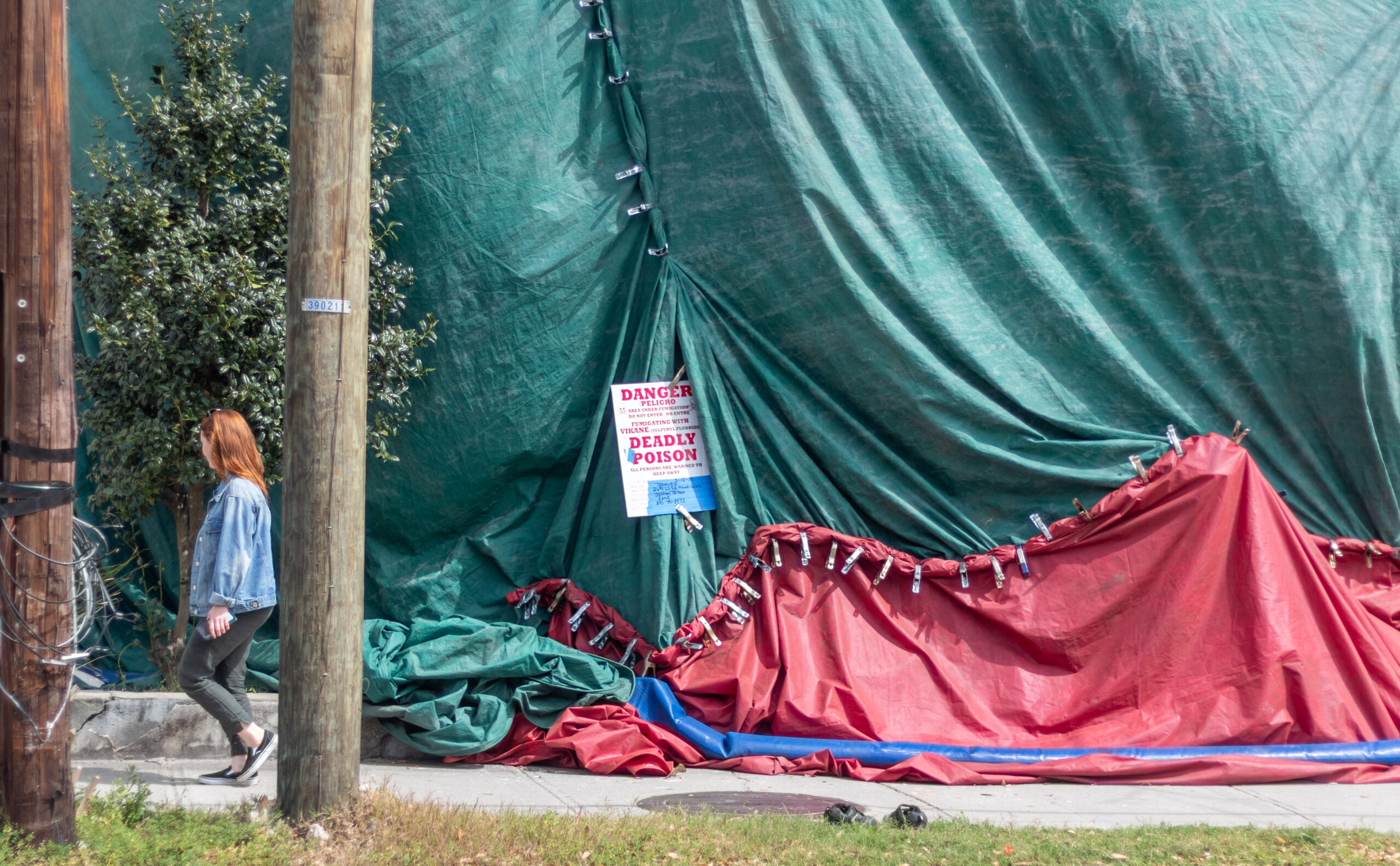
The crew covers the building with tarps and seals the edges at ground level so the gas stays inside. Florida rules require the structure to be made as gas-tight as practicable and do not allow fumigation of buildings that cannot reasonably be sealed or tented.
2. Locks and warning signs
No-entry warning signs are posted at the entrances. In California, the company must also put a secondary lock on every outside door that only the company can open.
3. Warning agent, then the fumigant
Sulfuryl fluoride is colorless and odorless, so a strongly irritating warning agent, chloropicrin, is released first to drive out anyone who enters. The fumigant is then released and held for the time set by the label.
4. Aeration and clearance
The tarps come off and fans push the gas out. The applicator then measures the air. NPIC notes that occupants may not return until levels are at or below EPA’s limit of 1 part per million.
How to Prepare: A Homeowner Checklist
Your fumigation company will give you written instructions, and those come first because they follow the product label. NPIC and California’s Structural Pest Control Board describe the same core steps.
Scroll the table sideways to see every column.
| What | What to do | Why |
|---|---|---|
| People and pets | Everyone leaves, including fish, reptiles, and birds. Ask neighbors to keep children and pets away from the tent | The gas is toxic to all living things |
| Houseplants | Move them out, along with seeds or bulbs meant for planting | Plants inside are killed or damaged |
| Food, pet food, tobacco, medicine | Remove them or seal them in the special fumigation bags the company provides, unless they are in unopened glass, metal, or sealed plastic containers. This includes the refrigerator and freezer | Food and medicine must not absorb the fumigant |
| Mattresses and pillows | Remove waterproof or plastic covers | Covers can trap pockets of gas |
| Doors, drawers, appliances | Open interior doors, closets, cabinets, drawers, and appliances such as dishwashers and microwaves | The gas has to reach every space, and clearance has to work everywhere |
| Flames and heaters | Turn off pilot lights and open flames; unplug or switch off heating elements and automatic controls | Follow NPIC and the company’s instructions, even though the gas is not flammable at room temperature |
| Keys and contact details | Agree who holds the keys and how the company will tell you the house is cleared | No one may enter until the re-entry notice is posted |
Plants along the foundation and the roof can also be affected by the work. UC IPM notes that roofs can be damaged when tarps are dragged across them or walked on, so ask the company how it protects the roof and the landscaping, and photograph both beforehand.
The Paperwork You Should See
Rules vary by state, but in California the company must have an occupant fumigation notice signed by you or your agent before it applies the fumigant. It names the pest, the pesticide and its active ingredient, the dates, and a warning that it is unsafe to return until a re-entry notice is posted. When the house is cleared, the company posts a re-entry notice with the release date and time, the company’s name, license, and phone number, and the fumigant used.
Federal labels changed in 2024. EPA approved revised labels for sulfuryl fluoride in July 2024 that require clearly posted no-entry signs, a site-specific fumigation log for residential jobs, longer aeration times, and clearance testing with portable devices that meet EPA’s performance criteria. Before you sign, ask which clearance device the company uses and whether you can get a copy of the fumigation log for your house. In Hawaii, the work must also be supervised by an applicator certified in fumigation; our Hawaii termite guide covers that state’s rules.

Is It Safe to Go Back In?
Sulfuryl fluoride is highly toxic to breathe, and California’s consumer guide warns that even a few minutes of exposure inside a tented house can cause death or serious injury. The safety system rests on keeping everyone out until the licensee in charge certifies the house safe and posts the re-entry notice. Do not go back early to pick something up, even with the tarps off.
After clearance, NPIC says residues are not expected to remain on surfaces. Florida rules also require that an entire multi-unit building be vacated and cleared, so a single unit in a shared building is not tented on its own. If anyone in the house has a medical condition that makes you concerned about a return, ask the company for the clearance readings and call the National Pesticide Information Center at 800-858-7378.
Safety note: Fumigation is restricted to certified applicators. Never enter a tented building, never remove warning signs or secondary locks yourself, and keep children and pets away from the tent and its edges until the company says the work is finished.
After Fumigation: What It Does and Does Not Do
- It kills the colonies it reaches. UC IPM says sulfuryl fluoride kills drywood termites within several days and that monitored fumigation, with gas lines that measure the concentration inside, has the highest success rate.
- It leaves no protection behind. There is no residue, so new swarmers can start colonies later. UC IPM notes that preventive treatments can be applied afterward for longer-term protection.
- It does not remove evidence. Old pellets and damage stay where they are. Clean up pellets after treatment and watch for new piles in the same places; our guide on how to know if termite treatment worked explains what to look for.
- It does not repair wood. Damaged members still need to be assessed; see how to assess and repair termite damage.
What It Costs
Fumigation is priced by the volume of the structure, so it usually sits at the high end of termite treatment costs. Add hotel nights, boarding for pets, and replacing food you did not want to bag. Our termite treatment cost guide compares whole-house fumigation with other methods.
Evidence in one small area
Ask for a written map of where termites were found, and whether a localized treatment could cover it. Compare the scope and the warranty with a whole-structure quote before deciding.
Evidence in several rooms or unknown extent
Whole-structure fumigation or heat is usually the comparison. Get the preparation list, the expected dates, the clearance method, and the warranty in writing before you book.
Our questions to ask a termite company work for fumigation quotes too. The termite treatment types guide puts fumigation next to heat, liquid, foam, and bait options, and the drywood termite guide covers the signs that usually lead to tenting. This guide summarizes labels and state rules and is not legal advice; follow your company’s written instructions and the rules where you live.
Your Next Step
If a company has recommended fumigation, ask for three things in writing before you book: where termites were found and which species, the full preparation list and expected dates, and how the house will be cleared and who will tell you it is safe to return. If the evidence is limited, ask for a localized option to compare.
Common Questions
How long do you have to stay out after termite fumigation?
It depends on the house, the dose, and the temperature. California’s consumer guide gives a range of six hours to a week. You return only after aeration, air testing, and a posted re-entry notice.
Do I have to bag the food in my refrigerator?
Yes, unless it is in unopened glass, metal, or sealed plastic containers. Remove it or seal it in the fumigation bags the company provides, following its instructions.
Does fumigation kill subterranean termites?
It is not designed for them. Subterranean colonies live in the soil, which the gas inside the tent does not reach, so they are treated with soil applications or baits.
Will termites come back after tenting?
Fumigation leaves no residue, so it does not stop new colonies. Watch for fresh pellets or swarmers in later seasons and ask about preventive treatment and inspections.
Is heat treatment an alternative?
NPIC calls heat the only whole-structure alternative to fumigation. UC IPM notes that heat needs hours rather than days away from home but can struggle with large beams and heat-sensitive items.
Sources and Further Reading
- National Pesticide Information Center — Structural Fumigation
- UC IPM — Pest Notes: Drywood Termites (Publication 7440)
- California Structural Pest Control Board — What You Should Know About Fumigation (rev. 03/2019)
- U.S. EPA — Next steps to protect people from sulfuryl fluoride used to fumigate residential structures (July 30, 2024)
- Fla. Admin. Code R. 5E-14.111 — Fumigation requirements: application, restrictions, and precautions